Background Research
Ideation Journey
The BloomLight design evolved through several iterations as we explored different ways to transform post-consumer waste into a functional furniture product. Each concept taught us valuable lessons about material behavior, manufacturability, and design feasibility.
Vinyl Bowl
Our first concept explored reshaping vinyl records into decorative bowls using heat. While the idea showed promise for repurposing a common post-consumer material, the bowls produced were too small for practical everyday use.
Layered Vinyl Plant Hanger — "Layered Echo"
We pivoted to a plant hanger formed from interwoven vinyl buckets. The concept involved heating vinyls to warp around each other, then weaving them together through the center holes with decorative threads or cables. This was presented at our design review.
Vinyl Lamp
Next, we attempted to form a lamp shade from heated vinyl records. However, the vinyl melting process proved unreliable — small records (45 RPMs) were too small to form a usable shade, while larger records evaporated and formed bubbles when heated, producing inconsistent and structurally unsound results.
Metal Lamp — BloomLight (Final)
After extensive experimentation, we pivoted to scrap sheet metal as our primary shade material. Metal petals offered structural integrity, consistent manufacturability, and a striking aesthetic. Combined with a 3D-printed PLA base and arm, this became the BloomLight.
Why We Moved Away from Vinyl
Our experiments with vinyl records revealed fundamental material limitations. Small 45 RPM records warped into shapes that were too small for functional use, while larger records developed bubbles and surface evaporation during the heating process, making them structurally inconsistent and unsuitable for a reliable product.
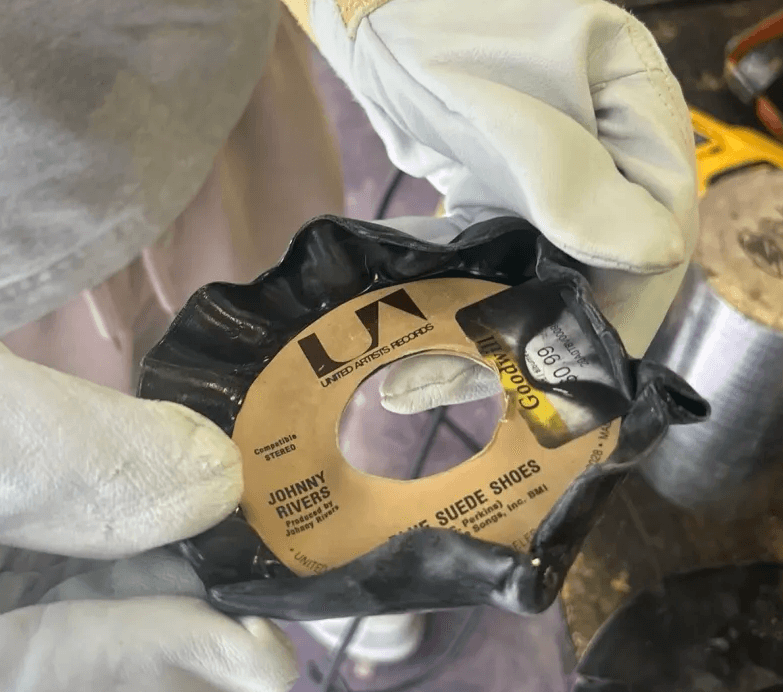
Small vinyl record warped by heat — too small for practical use
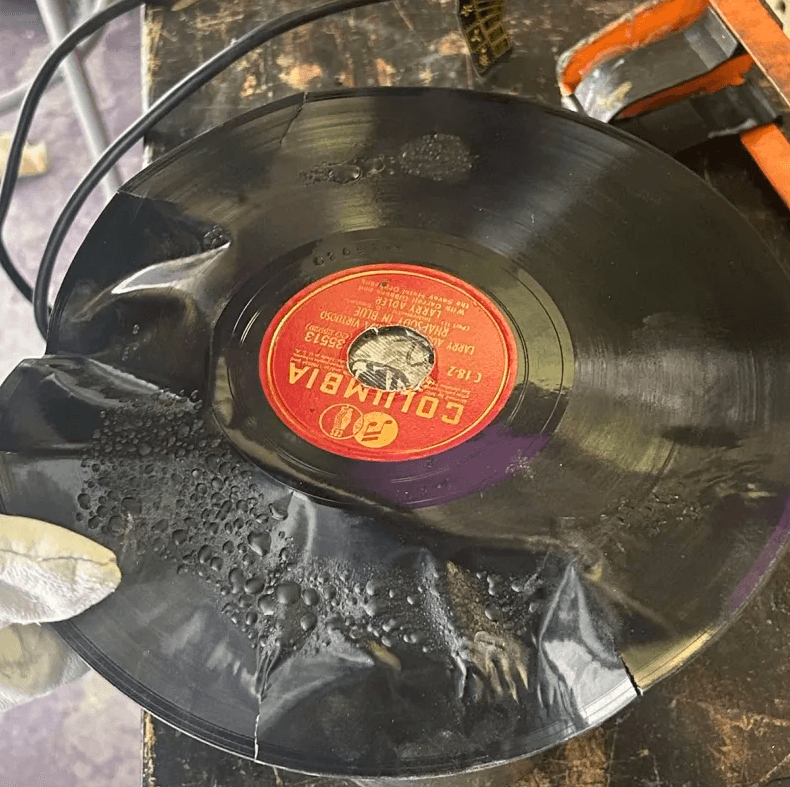
Large Goodwill record showing bubbling and surface damage from heating
Appendix A: Design Review Summary
Our design review was conducted on February 19, 2026 at the Ford Motor Company Engineering Design Center. At that stage, the design was centered around “Layered Echo”, a plant hanger formed with interwoven vinyls.
Key Concerns Identified
- •Manufacturing: Inconsistencies in heating vinyl. The PVC deformed irregularly and lattice structure changes could affect ductility and fracture characteristics.
- •Marketing: Emotional reaction to repurposing collectible vinyls, perceived durability of brittle material, and price justification for post-consumer waste products.
- •Disassembly: Complexity of replacing threads or vinyls. We aimed for tool-free “clean” disassembly inspired by Honest Structures.
Reviewer Feedback
Fabrication
Standardize heating method; research drilling for PVC; define safety protocols.
Lifecycle
Clarify repair, reuse, and recycling strategy; address toxicity of heating vinyl.
Aesthetics
Lean into bold color and record character; embrace variation as a strength.
Audience
Narrow target demographic; test with different groups; decide functional vs. art object.
Appendix B: Interview with Dr. Hemant Jha
On January 18, 2026, our team conducted an in-person interview with Dr. Hemant Jha, Adjunct Lecturer at Northwestern’s Segal Design Institute and founder of Honest Structures. The interview established the foundational principles guiding our design approach.
Design for Disassembly
Prioritize mechanical fastening methods like weaving over permanent bonds (glue). Materials should remain separable at end of life to ensure continued reusability. This means preventing the product from becoming unrecoverable waste.
Material Selection
Target obvious post-consumer items or engineering manufacturing waste. The design should embrace the origin of materials rather than hiding them. Examples shared included chairs from laminated cardboard, lamps covered in tennis balls, and bags from used denim/fabric scraps.
Marketing Strategy
Two approaches: either leverage the sustainability story to motivate consumers, or focus purely on the product's design merit. Dr. Jha cited Patagonia as a model for "doing the right thing". This can encourage consumers to take a chance on a product.
Transparency & Storytelling
Document the product's journey from waste to finished piece. Visible reuse, paired with professional craftsmanship, builds trust and validates the sustainability idea that we wish to pursue.
Commercial Viability
Pricing should be grounded in actual labor time using a minimum hourly wage. Durability can be validated by recruiting volunteers to test under harsher than typical conditions within the project quarter.
Appendix C: Literature Review
Project: Waste to Worth Lamp
Introduction
The Waste to Worth lamp explores how post-consumer materials can be transformed into a structurally stable and commercially viable lighting product. The design consists of three primary components: a 3D printed structural tube and structural base, and a conical shade the shape of a flower, formed from sheet metal petals. While the concept emphasizes reuse of discarded materials, existing research shows that successful sustainable design depends on more than material substitution. Structural performance, lifecycle impact, disassembly planning, and consumer perception all determine whether a recycled product can function effectively and compete in the marketplace. This review synthesizes scholarship on circular design frameworks, recycled material performance, lifecycle assessment, disassembly evaluation, and consumer acceptance to frame the design challenges of the Waste to Worth lamp.
Circular Design and Product Architecture
Circular economy research consistently identifies design as the primary leverage point for sustainability. The Ellen MacArthur Foundation argues that the most impactful sustainability decisions occur during product development, particularly through modular construction, durability, and design for disassembly [1], [2]. These principles support the lamp's component-based structure, in which the printed tube, and sheet metal shade remain separable rather than permanently bonded. Designing components for potential replacement or recovery aligns with circular strategies that prioritize material longevity.
The European Environment Agency further emphasizes that reuse and extended product lifespan provide greater environmental benefit than recycling alone [3]. This is directly relevant to our lamp as we aim to focus around tough, rugged materials like polylactic acid (PLA) and steel sheet metal that are more difficult to recycle, but as shown, can be reused to extend the product lifespan and fuel our lamp design. Circular design therefore requires that the lamp be durable, repairable, and structurally intentional rather than merely composed of recycled parts.
Recycled Materials and Structural Feasibility
Material research suggests that post-consumer waste can achieve structural viability when engineered properly. Wang et al. demonstrate that discarded textiles can be processed into rigid composite panels capable of replacing wood in furniture applications [4]. Similarly, Agbakoba et al. analyze recycled PLA in 3D printing and find that although higher recycled content reduces tensile strength, thermal stability remains comparable to virgin filament [5]. Their findings indicate that waste materials can transition from soft, low-value inputs to load-bearing structural elements when appropriate binders and processing methods are applied. Agbakoba's research is relevant as it supports the feasibility of using PLA filament as a stable base if compression is engineered carefully [5]. Together, these sources point toward the union of woven/welded sheet metal petals to reinforce the structural integrity of the lamp, along with the natural material rigidity that PLA presents for the base and arm. This research directly informs the central 3D printed tube of the lamp. If recycled PLA is used, mechanical properties must be evaluated to ensure safe support of the bulb housing and shade.
Structural orientation and configuration also influence performance. Garbowski et al. demonstrate that load-bearing capacity in corrugated materials depends significantly on orientation and stress distribution [6]. Although their study focuses on cardboard, the broader principle applies. The structural integrity of stacked petals depends on alignment, compression strategy, and load transfer. These studies collectively reinforce that recycled materials require mechanical validation rather than aesthetic assumption.
Lifecycle Impact and Environmental Justification
Lifecycle assessment research strengthens the environmental argument for reuse-based design. Abagnato et al. review textile reuse studies and conclude that material recovery significantly reduces energy consumption and emissions compared to virgin production [7]. Blengini and Busto similarly identify raw material extraction and manufacturing as the most environmentally intensive phases of furniture production [8]. By utilizing already-produced vinyl records and potentially recycled filament, the lamp reduces reliance on new raw materials.
However, lifecycle literature also emphasizes durability as a condition for environmental benefit. If a product fails prematurely, environmental gains diminish. The lamp must therefore meet structural and aesthetic expectations to justify its sustainability claims.
Manufacturing
Our main concern for manufacturing the proposed lamp revolves around securing the sheet metal petals together. Messler identifies welding, riveting, and mechanical fastening as common joining methods for thin sheet metal structures [18]. This overview is relevant as it highlights the trade-off between permanent structural strength and disassemblability.
Several papers emphasize mechanical fastening methods. Hoang et al. find that self-piercing riveting creates strong joints in thin sheet metal without requiring a heat input [19]. This aligns with Messler's broader note that mechanical joining methods are effective for relatively thin materials and allow easier component replacement. For our project, this suggests rivets or bolts as possible securing methods while maintaining modularity.
Other research papers suggest welding. Kou explains that fusion welding processes such as TIG welding (offered in the Ford Prototyping Shop) can create strong permanent joints in thin metal sheets when heat input is controlled [20]. This source agrees that welding offers strong structural joints but reduces disassembly potential.
Design for Disassembly
Disassembly research further clarifies circular performance requirements. Hybel et al. propose a quantitative method for evaluating component-level disassembly efficiency and identify adhesives and hidden connectors as significant barriers to recovery [9]. Their findings support the use of natural mechanical fasteners (such as dovetail connectors or dowel pins) and accessible assembly systems in the lamp's construction. A modular configuration not only aligns with circular principles [1] but also enables repair and potential material recovery at end of life.
Material Sourcing
Research on distributed recycling suggests that waste streams from manufacturing environments can provide viable material sources for sustainable design projects. Sanchez et al. identifies failed prints, supports, and excess filament as significant waste stream in additive manufacturing (AM) plants, arguing that these materials are an underutilized resource for circular production systems [13]. This observation aligns with Ragaert et al., who notes that the thermoplastic polymers like PLA can be recycled through shredding and remelting machines with relatively low thermodynamic energy input as compared to 100% virgin plastic production [14]. Overall, these research papers suggest that discarded PLA from AM plants or maker spaces (like the Northwestern Maker Lab) can be repurposed into new printed components.
Baechler et al. extends this idea by showing that distributed recycling systems can convert plastic waste directly into usable recyclable filament for AM, enabling local circular material loops [15]. Krieger and Pearce similarly find that converting post-consumer plastics into 3DP filament significantly reduces environmental impact as compared to typical plastic manufacturing like SLS or injection molding [16]. Collectively, these sources point to the feasibility of sourcing recycled PLA for the lamp's structural base and tube from discarded prints or filament.
A comparable recovery system exists for metals. The US Environmental Protection Agency (EPA) notes that metals are among the most successfully recovered materials in global recycling systems purely due to their durability and economic value [17]. Manufacturing processes that cut or stamp sheet metal routinely produce offcuts that remain usable despite no longer fitting their original purpose. For our lamp design, this research is important as it supports sourcing sheet metal petals from scraps rather than virgin stock.
Consumer Perception and Market Viability
Even when structural and environmental criteria are satisfied, consumer perception remains critical. Polyportis et al. find that perceived quality, aesthetics, and functional reliability strongly influence acceptance of recycled products [10]. Environmental concern alone does not determine purchase intent.
Sumter et al. report that visible reuse in repurposed furniture can generate negative associations related to quality and hygiene [11]. Van Hees et al. similarly identify negative public quality perception as a major barrier to scaling upcycled furniture businesses [12]. These findings indicate that the lamp must communicate craftsmanship and intentional design. Clean finishing, precise stacking, and professional presentation are necessary to overcome stigma associated with post-consumer materials.
Conclusion
The literature positions the Waste to Worth lamp at the intersection of circular design theory, material engineering, and consumer psychology. Circular frameworks emphasize modularity and longevity [1], [2], while material studies confirm that recycled components can achieve structural viability when engineered carefully [4], [5]. Lifecycle assessments demonstrate environmental benefits when reuse extends product life [7], [8]. However, consumer perception research reveals that quality signaling and professional finishing are essential for commercial acceptance [10]–[12].
The success of the Waste to Worth lamp therefore depends on integrating structural validation, disassembly planning, and refined presentation into a cohesive design. Sustainability is defined not only by material origin but by durability, functionality, and perceived value.
Appendix D: Instructions for Use
Assembly Steps
- Place the 3D-printed base on a stable, flat surface such as a table or desk.
- Insert a lightbulb into the lightbulb socket.
- Turn the bulb clockwise until firmly secured.
- Place the power cord so it runs safely from the lamp to the nearest outlet.
- Insert the plug into a North American electrical outlet.
- Press the power switch on the lamp arm to turn the lamp on.
Note: Do not overtighten the bulb as this could damage the socket.
Safety Notes
- •Do not touch the light bulb immediately after turning off — it may still be hot.
- •Do not expose the lamp to water or moisture.
- •Keep the lamp on stable surfaces to prevent tipping.
Troubleshooting
- •Won’t turn on: Check outlet, confirm bulb is fully seated, test outlet with another device.
- •Unstable: Confirm flat surface and that the stem is fully inserted into the base.
- •Flickering: Turn off and tighten the bulb slightly clockwise.
Maintenance
Clean the metal petals and base with a dry cloth. Avoid using water or liquid cleaners on electrical components.